
RRBs were formed under an Act to provide credit to small farmers, agricultural labourers and businesses in rural areas.

State-owned companies have been set stiff targets to increase accountability as they get ready for divestment. Nikunj Ohri explains why meeting them will be challenging.

A user just needs to download any app floated by such fraudsters and apply for instant loans. These apps are mainly concentrated on Google Play considering the reach and popularity of Android systems.

Industry players believe the new DFI model will be initially risk capital, which will then be used to mobilise additional resources from development agencies such as World Bank.

The hoarding of cash accentuated from the very start of 2020, when the coronavirus pandemic started taking hold the world over, and fear of the pandemic prodded people to remain liquid for emergency use.
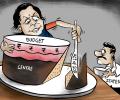
It is estimating that this would help monetise assets worth Rs 10,000 crore.

'The financial sector's performance in the first two quarters was a revelation.' 'It clearly showed the clean-up had been done in the past one-and-a-half years and that capital brought in was significantly stronger.'
About 50 per cent of the accounts that availed of the EMI moratorium amid the pandemic, which made things worse in an already slowing economy, are expected to be restructured, and of these accounts that would undergo restructuring, one-third, or Rs 6-9 trillion, could turn into NPAs.

The paper seems to be suggesting strongly that the tight target range be maintained even as the central bank is all set to miss the target range for three consecutive quarters because of the Covid crisis.

Economists praise Das for his pragmatism and willingness to face challenges head on. And in doing so with the finesse of an able administrator.

According to the Trends and Progress Report of the RBI, 98 per cent of frauds in terms of value were related to loans, and their occurrence was spread over several previous years.

While lenders create a hype around the services offered on digital platforms, customers think otherwise, given that frustration due to the quality of service has only increased, over the years.

In a bid to gain a bigger share of the customer's wallet, banks are ramping up their cross-selling initiatives.

The interest rate offered by PSBs like SBI, BoB and BoI hover around 8.9 per cent-10.50 per cent. For private banks, the range is between 10.49 per cent and 12 per cent.
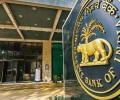
The RBI governor is focused on growth, and keeping rupee slightly depreciated is part of that 'Atmanirbhar Bharat' strategy.

But what do banks gain by opening their apps for all? The answer -- rival bank's customers under their fold.

'We tightened our risk frameworks once the Covid crisis started.' 'We are slowly lightening this as we see economic activity pick up, salaries getting restored, and people getting back into jobs.'

'When there is unlocking, there is demand revival.' 'This is going to be the main growth engine in this kind of an economic scenario.'

NBFCs with a proven track record, supported by the brand values of reputed corporate, can play a key role in bringing the benefits of banking and economy to the underserved and newer segments of India.
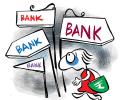
Banks now ride on what is defined as a "banking outlet". This is a fixed-point service unit, manned by either the bank's staff or its business correspondent (BC), where all kinds of services - acceptance of deposits, encashment of cheques, cash withdrawal or lending of money - are provided for a minimum of four hours per day, for at least five days a week. Banks are now turning to reposition the manner in which they acquire customers, report Abhijit Lele and Raghu Mohan.
 © 2026 Rediff.com - Investor Information - Advertise with us - Disclaimer - Privacy Policy - Sitemap - Feedback - About us - Terms of use - Grievances